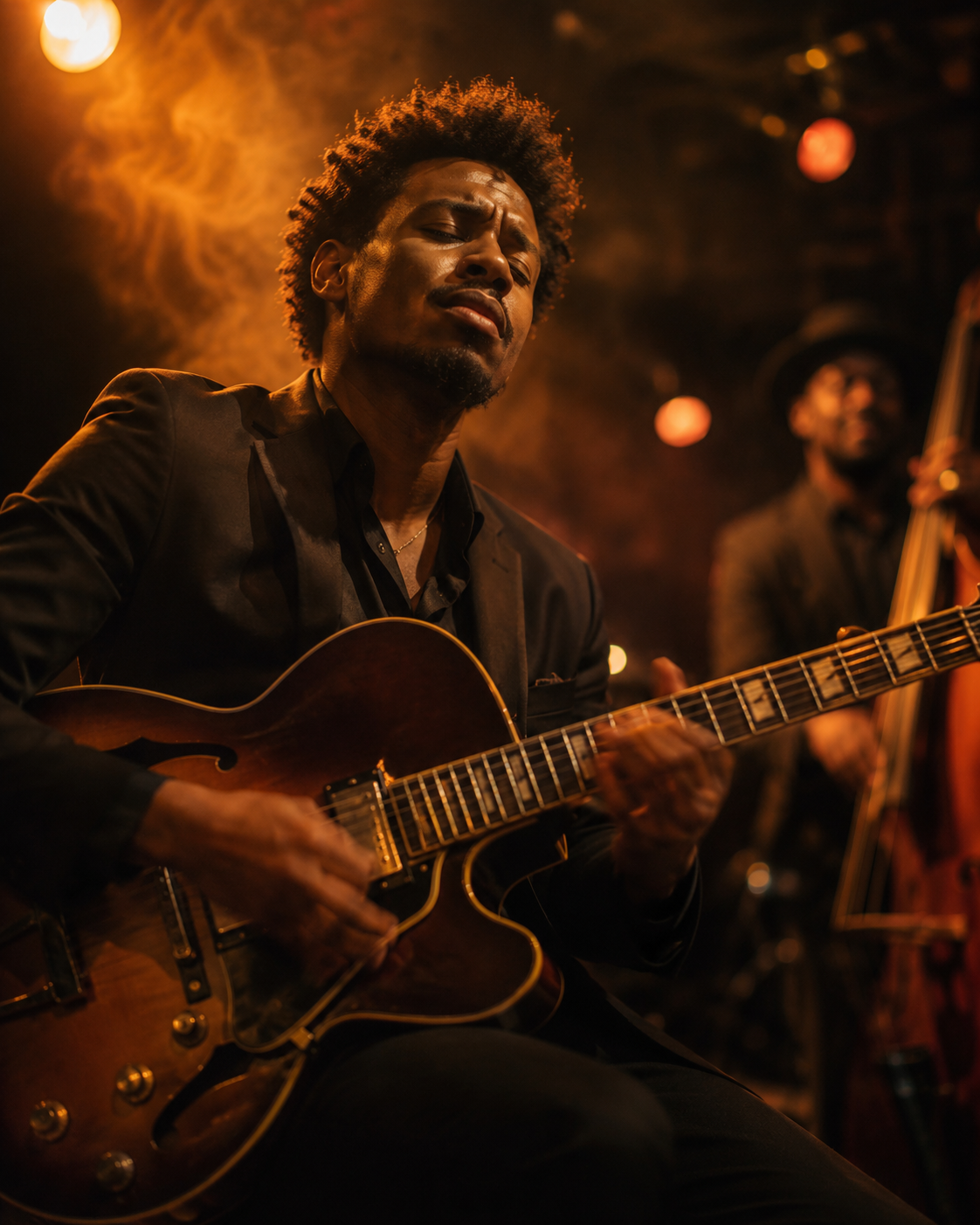
For a long time “flow” was a feeling you could describe but not point to. Now we can watch it happen.
When researchers at Drexel put EEG caps on 32 jazz guitarists and recorded them improvising, the high-flow takes had a surprising signature: less activity in the brain’s frontal control centers, not more. Flow is not white-knuckle concentration. It is the controlled release of control, the moment the conscious supervisor steps back and lets a trained network run on its own (Creative flow as optimized processing, Neuropsychologia, 2024).

The catch, and it is the whole point, is that the network has to exist first. The most experienced players dropped into flow more often and more deeply. You cannot let go of something you have not built.
Freestyle rappers show the mirror image of the same idea. Scanned mid-improvisation, their medial prefrontal cortex, the part tied to motivation and self-generated thought, lights up, while the dorsolateral region that normally edits and second-guesses goes quiet (Liu et al., Scientific Reports, 2012). The internal critic clocks out. The voice keeps going.
This is the engine behind everything we make. The discipline is invisible by the time the work looks effortless. That is not a contradiction. It is the mechanism.
Sources: Creative flow as optimized processing · Scientific American, Brain Scans of Jazz Musicians · Liu et al., fMRI of Freestyle Rap